Workflow Automation for Ecommerce Video Production
Automate ecommerce video production with AI workflow. Turn product feeds into platform-native video ads for Shopify, Amazon and TikTok Shop at catalogue scale.
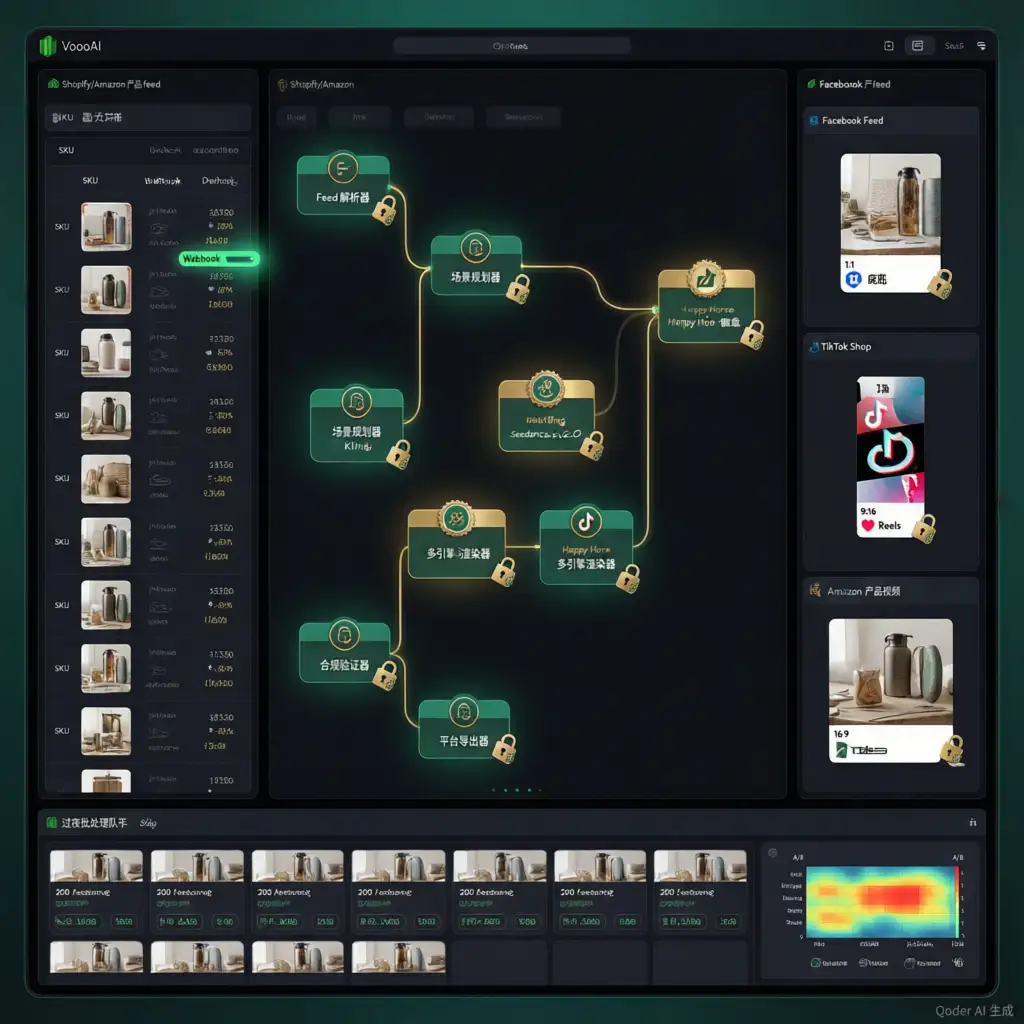
VoooAI's workflow automation for ecommerce video turns your existing product catalogue into a continuous video production pipeline. Instead of treating each SKU as a one-off creative project, you define a reproducible workflow graph once — product feed ingestion, scene planning, multi-engine rendering, platform-native export — and let the system regenerate the entire catalogue whenever inventory, pricing or creative direction changes. This is the same philosophy that drives no-code automation platforms, but purpose-built for video output rather than data plumbing, and grounded in the reality that ecommerce teams now measure creative volume as a paid-media KPI rather than a production expense.
Why Ecommerce Video Needs Workflow Automation
Traditional video production breaks down at catalogue scale. A brand with 200 SKUs cannot afford a $400-800 freelance shoot per product, nor can it wait 5-7 business days for each variant. The bottleneck is not creative quality — it is the inability to reproduce a winning template across hundreds of products without manual re-editing. Workflow automation solves this by treating each video as a node in a directed graph: inputs (product images, descriptions, pricing) flow through deterministic transformation steps (scene selection, text overlay generation, soundtrack matching) and output platform-native assets in 1:1, 9:16 and 16:9 simultaneously. When a product feed updates, the entire downstream pipeline re-executes without human intervention.
The Product-Feed-to-Video Pipeline
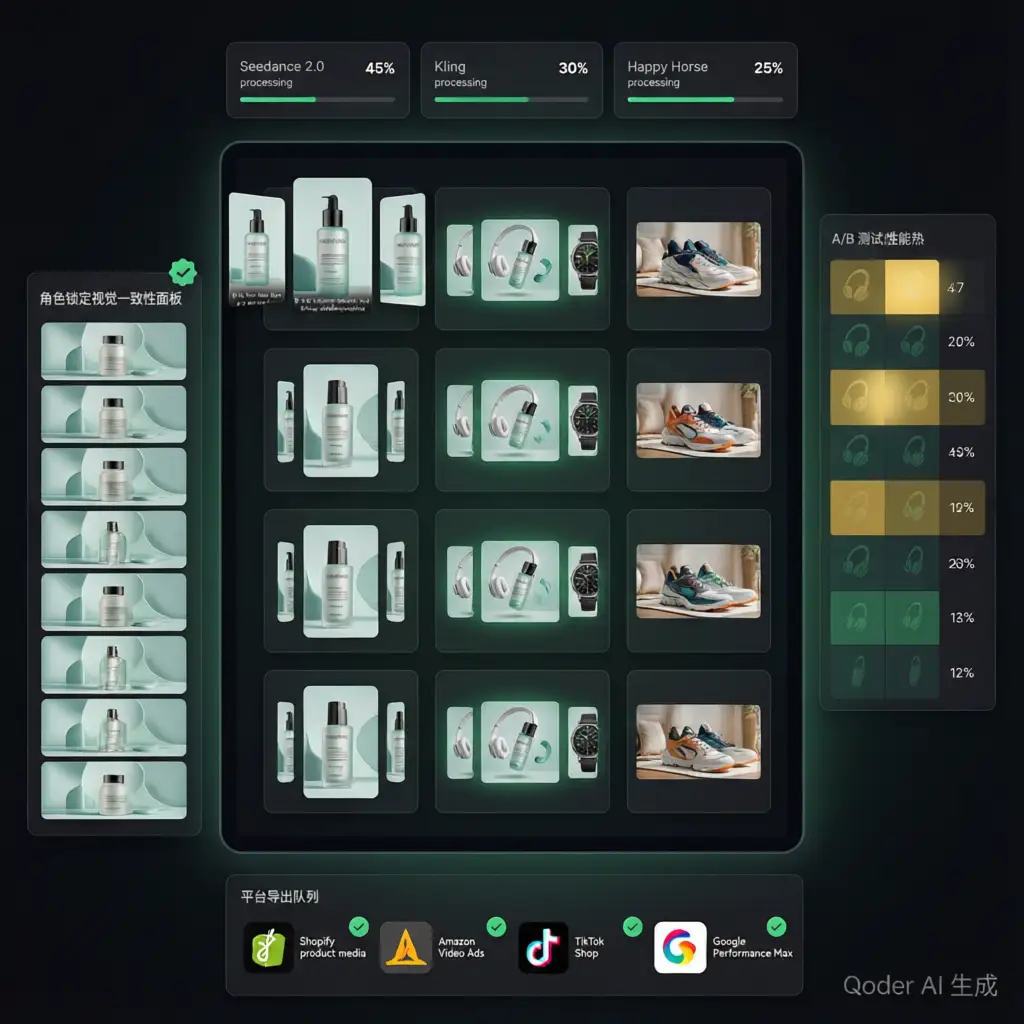
VoooAI's NL2Workflow engine parses your product feed — CSV export from Shopify, Amazon listing JSON, or a simple Google Sheets URL — and generates a complete video workflow graph. Each product becomes a workflow instance with its own scene plan, character-locked visual consistency (so the same product always looks like the same product across variants), and platform-specific export presets. The pipeline supports three rendering engines in parallel (Seedance 2.0 for cinematic motion, Kling for product-focused realism, Happy Horse for stylised animation), automatically selecting the best engine per product category based on historical performance data. A single generation call produces three platform-native variants ready for Meta Ads Manager, TikTok Ads Manager and Google Performance Max upload.
Batch Generation Across SKU Catalogues
The key advantage for ecommerce sellers is batch capacity. Instead of creating one video and hoping it performs, generate 10-20 variants per SKU with different hooks, music, text emphasis and camera movements. Run them as A/B tests across platforms and let data decide which converts best. Paid media teams consistently report that the first three variants are rarely the winners; the real conversion uplift usually shows up in variant 7 through 12, which is exactly why batch capacity matters more than single-video quality. VoooAI's overnight batch mode can process an entire 200-SKU catalogue while you sleep, delivering 600+ platform-native assets by morning — output that would take a traditional production team two weeks and $80,000+ to replicate.
Platform-Native Output Without Re-Rendering
Every generated asset ships in the exact specification required by its destination platform. Square (1:1) for Facebook Feed and Instagram Grid, vertical (9:16) for Reels, TikTok and YouTube Shorts, landscape (16:9) for in-stream placements and Amazon product video slots. The workflow graph includes platform-specific compliance checks: Meta and TikTok Shop both auto-reject ads with unverifiable price claims, so the engine validates headline numbers against your landing page before export. According to [Kanopy's Google Merchant Center video link guide](https://kanopy.me/resources/google-merchant-center-video-link), adding video feeds to your Merchant Center listings significantly boosts product visibility in Shopping results, and preparing for future image rules now means your video assets will remain compliant as Google tightens its product media requirements through 2026.
Shopify Integration: Webhook-Triggered Production
Shopify merchants can wire VoooAI's workflow to a product-feed webhook so that every new listing auto-triggers three platform-native ad variants before a human ever reviews the page. The integration works through Shopify Admin API: when a product is created or updated, the webhook fires, VoooAI ingests the product images and description, and the rendered assets land directly in the product media gallery. According to [Shopify's Videomagic app listing](https://apps.shopify.com/videomagic), the most successful ecommerce video tools share three traits: one-time pricing without subscription fatigue ($15-270 for 50-1000 credits), Auto mode that plans the entire video from image selection to prompt and settings, and one-click publish to product media. VoooAI's workflow automation extends this pattern from single-product generation to full-catalogue orchestration, blending up to 7 product photos into 6-scene multi-shot sequences that maintain consistent visual identity across every variant.
Amazon FBA and Multi-Channel Distribution
Amazon FBA sellers typically export the listing CSV and run an overnight batch against the whole catalogue. The output lands in a shared asset library ready for Amazon Video Ads, Sponsored Brands Video and A+ Content video modules. For brands selling across Shopify, Amazon, WooCommerce and TikTok Shop simultaneously, the workflow graph maintains a single source of truth: one product feed update propagates to all channels within minutes, eliminating the usual round-trip between creative production and media buying. Teams that want tighter control can hand the generated short videos to an editor for a final pass rather than shipping the raw AI output directly, but most find that the character-locked consistency and platform-native compliance checks make human review optional rather than mandatory.
Cost Benchmarks: Automation vs Traditional Production
A typical 15-second product ad through a freelance video producer averages $400-800 and 5-7 business days of back-and-forth. VoooAI completes the same output in roughly 3 minutes of compute time and lets you ship twenty variants for the cost of one traditional shoot. For comparison, [Shopify's Vidify app](https://apps.shopify.com/vidify) charges $20-60/month for 20-60 single-image videos with 5-10 minute render times, which works well for solo merchants but does not scale to catalogue-level batch production. VoooAI's workflow automation is priced per compute credit rather than per video, making overnight batch runs across 200+ SKUs economically viable. For a brand running paid social across three platforms, automation typically translates to 40-60% lower creative cost per week and a noticeably shorter iteration loop between hypothesis and measurable results.
A/B Testing at Portfolio Scale
When you generate 10-20 variants per SKU across 200 products, you are not just A/B testing individual creatives — you are building a portfolio-level performance dataset. VoooAI's workflow graph tags every output with its generation parameters (engine used, scene count, hook style, soundtrack category), so you can correlate creative decisions with conversion outcomes across your entire catalogue. This transforms creative production from an art project into a measurable optimisation loop. Teams that adopt this approach typically find their top-performing creative patterns within the first two weeks, then lock those patterns into reusable workflow templates that auto-apply to every new product listing.
Common Pitfalls and How to Avoid Them
Three mistakes cost sellers the most ROAS when automating ecommerce video. First, using generic stock-style prompts: the more specific you are about the buyer persona and the pain point, the more click-through the opening 1.5 seconds will earn. Second, ignoring thumb-stop hooks: TikTok and Reels reward videos that change visually within the first beat, so configure the workflow to open on the product in motion rather than on a logo card. Third, skipping the compliance check: Meta and TikTok Shop both auto-reject ads with unverifiable claims, so keep headline numbers close to what appears on the landing page and let the workflow graph validate before export. A fourth, less obvious pitfall is treating automation as fire-and-forget: the highest-ROI teams review batch output weekly, prune underperforming variants, and feed winning patterns back into the workflow template.
Getting Started with VoooAI's Ecommerce Workflow
New users should start with the 'product-showcase-ad' template, connect their Shopify or Amazon product feed, and let the engine render three variants per SKU back-to-back. Pick the strongest opening hook, regenerate only the variants you dislike, and export the 1:1, 9:16 and 16:9 cuts in one click. To understand how the underlying automation pipeline fits alongside your existing martech stack, read our hub overview at [Best Workflow Automation Software for AI Video](/workflow-comparison) — it explains why we treat each ad spot as a reproducible workflow node rather than a one-off file, and compares VoooAI against manual editing tools and other AI video stacks specifically through the lens of batch reliability and workflow reproducibility. For a broader view of how the multi-model engine picks rendering strategy per product category, the [AI Video Generator](/ai-video-generator) Super-Hub is the recommended deeper read before you commit a full quarter of ad spend to a single creative pipeline.
Frequently Asked Questions
What is workflow automation for ecommerce video?
Workflow automation for ecommerce video means defining a reproducible pipeline that turns product feeds into platform-native video ads at catalogue scale. VoooAI's NL2Workflow engine parses your Shopify or Amazon product data, generates scene plans with character-locked visual consistency, and renders 1:1, 9:16 and 16:9 variants simultaneously — so a 200-SKU catalogue can produce 600+ assets overnight without manual re-editing.
How does VoooAI integrate with Shopify for automated video production?
VoooAI connects through Shopify Admin API webhooks: when a product is created or updated, the webhook fires automatically, VoooAI ingests the product images and description, and rendered video assets land directly in the product media gallery. This means every new listing gets three platform-native ad variants before a human ever reviews the page, eliminating the usual creative production bottleneck.
Can I generate videos for my entire product catalogue overnight?
Yes. VoooAI's overnight batch mode processes entire SKU catalogues while you sleep. Export your product feed as CSV from Shopify or Amazon, configure the workflow template once, and the system generates 10-20 variants per SKU with different hooks, music and camera angles. A 200-SKU catalogue typically delivers 600+ platform-native assets by morning — output that would take a traditional production team two weeks and $80,000+ to replicate.
What platforms support VoooAI's automated video output?
VoooAI exports platform-native formats for Shopify product media, Amazon Video Ads and Sponsored Brands Video, TikTok Shop, Facebook/Instagram Ads (Feed, Reels, Stories), Google Performance Max, YouTube Shorts, and WooCommerce — in square (1:1), vertical (9:16), and landscape (16:9) simultaneously. The workflow graph includes platform-specific compliance checks so assets pass Meta and TikTok Shop ad review before export.
How much does automated ecommerce video production cost vs traditional?
A traditional 15-second product ad through a freelance producer averages $400-800 and 5-7 business days. VoooAI completes the same output in roughly 3 minutes of compute time, priced per credit rather than per video. For comparison, Shopify apps like Vidify charge $20-60/month for 20-60 single-image videos, while VoooAI's workflow automation scales to 200+ SKU overnight batches. Brands running paid social across three platforms typically see 40-60% lower creative cost per week with automation.