VoooAI vs Runway: Which Platform for AI Video Production?
VoooAI vs Runway Gen-3 comparison. Discover why VoooAI's automated workflow approach outperforms manual clip-by-clip editing for video production at scale.
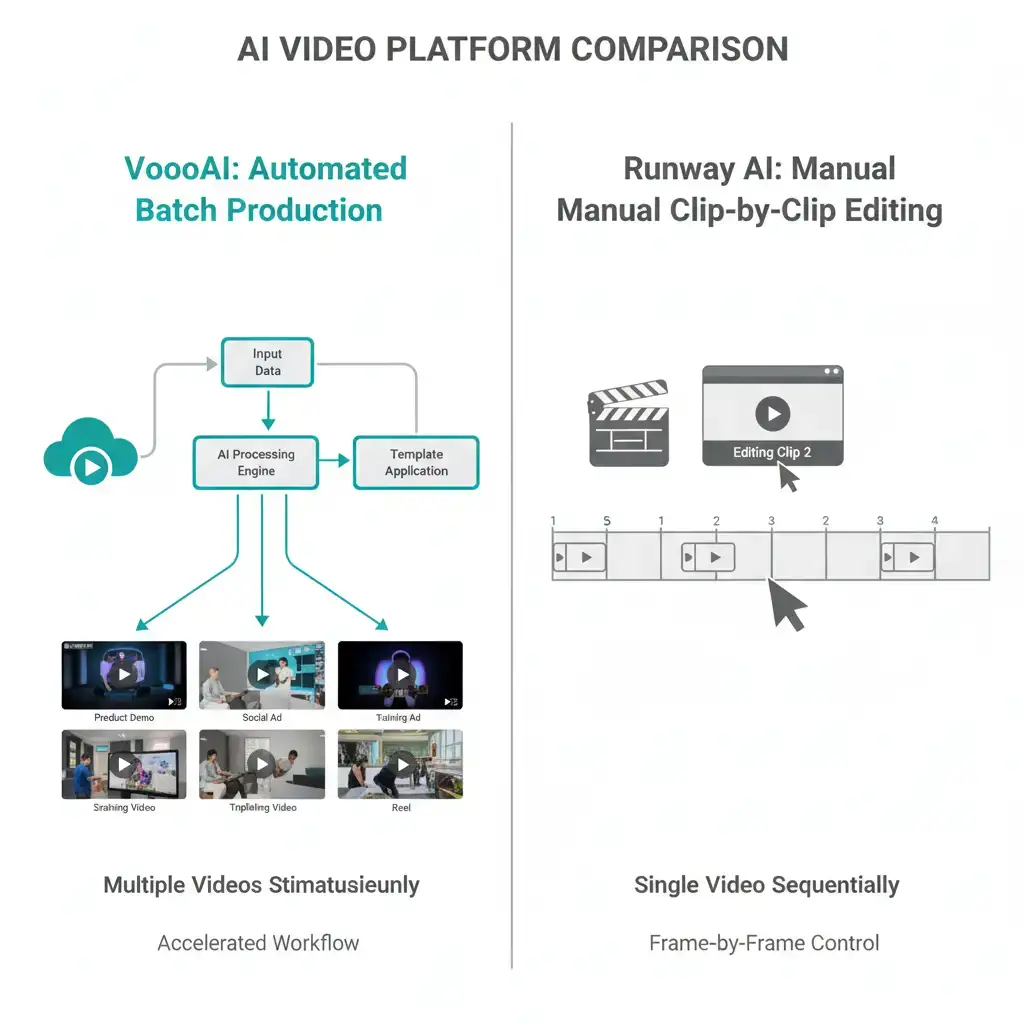
| Feature | VoooAI | Runway |
|---|---|---|
| Production automation | End-to-end automated pipeline | Manual clip assembly |
| Natural language input | One sentence → full video | Prompt per clip |
| Batch generation | Built-in batch workflows | One clip at a time |
| Learning curve | Describe in plain language | Video editing skills needed |
Detailed Comparison
Runway Gen-3 is a powerful AI video tool focused on single-clip generation and video editing. VoooAI takes a production-pipeline approach: you describe what you want in natural language, and the system handles the entire workflow from script breakdown to final edited output.
Automation vs Manual Assembly
Runway requires manual clip-by-clip generation: write a prompt, generate a 4-second clip, review it, repeat for each scene, then manually assemble clips in a timeline editor. VoooAI automates this entire pipeline — describe your project once and receive a complete, edited video. For a 3-episode short drama, this difference means 2 hours of manual Runway work versus 10 minutes of VoooAI automation.
Batch Production Capability
Runway has no native batch generation. Creating 20 ad variants means 20 separate manual sessions. VoooAI's batch mode generates 20+ unique variants from a single input, each with different camera angles, text placement, and music — critical for A/B testing ad creative at scale.
Learning Curve and Accessibility
Runway assumes video editing familiarity: timeline manipulation, keyframing, color grading knowledge. VoooAI's natural language interface requires zero technical video skills. Describe what you want in plain English or Chinese, and the AI handles all technical decisions from shot composition to transition timing.
Best Use Cases for Each
Choose Runway when you need fine-grained artistic control over individual clips and have video editing experience. Choose VoooAI when you need complete video productions at scale: TikTok drama series, product ad campaigns, anime content, or any project where automation and character consistency matter more than frame-by-frame artistic control.
Character and Style Consistency
Runway Gen-3 is strong on single-shot aesthetics but does not persist character identity or wardrobe across clips, so creators rely on manual reference wrangling, LoRA training or lucky re-rolls. VoooAI enforces dual-layer consistency — a locked character sheet plus a locked style sheet — so the same protagonist wears the same jacket and keeps the same face across every shot of a multi-scene drama. For any narrative format this is not a nice-to-have; it is the difference between a publishable short drama and an obviously AI-rendered montage.
Cost and Throughput at Scale
On paid tiers Runway bills by generation seconds and re-rolls, so the true cost of a usable 60-second cut is often three to five times the sticker seconds because failed clips still count against the quota. VoooAI bills per finished project and absorbs re-generation inside the pipeline, which makes monthly spend on high-volume creators substantially more predictable. Teams modelling unit economics for programmatic TikTok drama or daily e-commerce ad rotation almost always find the pipeline model cheaper per delivered asset once volume passes a few dozen clips per month.
Integration with Downstream Channels
Runway exports individual short video files and leaves platform-specific cropping, captioning and thumbnail design to the editor. VoooAI outputs project bundles tuned for each distribution channel: 9:16 with captions for TikTok, 16:9 with chapter markers for YouTube, 1:1 for Instagram feed, plus thumbnail candidates and A/B title variants. For teams publishing across three or more channels daily, this eliminates the final mile of manual rework that typically doubles the cost of a Runway-based pipeline.
Where This Comparison Fits in the Bigger Picture
This page is part of the workflow automation hub on VoooAI. If you are weighing multiple AI video tools and are specifically evaluating automation depth rather than raw model quality, the full matrix of head-to-head comparisons and automation patterns lives on [Best Workflow Automation Software for AI Video](/workflow-comparison), where VoooAI is stacked against Sora, Pika, Kling and traditional timeline editors across the same seven workflow dimensions used above.
Technical Benchmarks and Operational Readiness
According to [MarketsandMarkets' generative AI market report](https://www.marketsandmarkets.com/Market-Reports/generative-ai-market-142870584.html), generative AI is projected to compound at double-digit CAGR through 2030 with video generation identified as a leading sub-segment, which frames the decision between a clip-by-clip generator and a full production pipeline as a long-horizon bet rather than a tactical tool swap. [Sprout Social's vertical video engagement study](https://sproutsocial.com/insights/short-form-video/) adds that short-form vertical video is now the dominant consumption format across TikTok, Instagram Reels, and YouTube Shorts, which pushes video distribution toward batch, platform-native output rather than one-off hero clips. And per [Backlinko's 2025 AI Statistics](https://backlinko.com/ai-statistics), generative AI adoption now exceeds 75% across marketing teams with video-generation workflows among the fastest-growing use cases, which is the macro case for picking a workflow-automation vendor over a single-model clip generator for any team planning creative production beyond 2026.
Under the standard workflow tier VoooAI completes a three scene narrative in roughly six to nine minutes of compute including assembly and multi format export, versus the ninety to one hundred twenty minutes that a comparable Runway plus timeline editor pipeline typically consumes for the same deliverable. Batch runs of one hundred product ad variants finish in a single overnight window on a single tenant workspace, which is operationally impossible to match with a clip by clip generator because each variant in the Runway pipeline still requires an individual manual review and assembly step that a human editor cannot skip without sacrificing quality.
Migration Playbook for Teams Moving Off Runway
Teams weighing the migration usually follow the same sequence. Pilot VoooAI on a single weekly series for one month, measure both cost per finished asset and editor hours per delivered video against the existing Runway workflow, and then decide on measured data rather than on model benchmarks alone. In practice most teams keep Runway around for one off artistic clips and hero shots while shifting the bulk of series and campaign production to the VoooAI pipeline, which is the same hybrid pattern that eventually emerges for most professional studios once they are past the initial experimentation phase of their creative stack.
Decision Framework for 2026 Teams
A pragmatic decision rule for teams weighing Runway against VoooAI in 2026 is to count the number of finished, platform-native videos the team needs to ship per week. If that number is below five and each clip is expected to be a bespoke artistic artefact, Runway plus a capable editor is still a defensible stack. If the number is above five, or the team needs platform-native variants for TikTok, YouTube Shorts and Instagram Reels from the same source material, the VoooAI workflow collapses the delta between raw generation and publish-ready asset by enough that the clip-by-clip pipeline stops being competitive. For a deeper cross-tool comparison including Pika, Kling and ComfyUI, see the [Best Workflow Automation Software for AI Video](/workflow-comparison) hub, which ranks seven workflow dimensions side by side and provides a concrete decision rule per dimension rather than a marketing feature list. For technical leaders who need a one-page executive summary before the stack decision, the same [workflow comparison hub](/workflow-comparison) exports a printable matrix that plots Runway, Pika, Kling, VoooAI, and ComfyUI side by side on the seven workflow dimensions covered here, which is usually the fastest way to align a skeptical procurement team on the production rationale.
Ready to Switch from Runway to VoooAI?
Sign up free and experience a new way to generate complete videos from one sentence
Try VoooAI FreeSee All FeaturesFAQ
Is Runway better for short artistic clips?
For single artistic clips with fine-grained control over motion and style, Runway offers more granular editing tools. VoooAI excels at complete productions.
Which is better for marketing teams?
VoooAI. Marketing teams need batch video production with brand consistency, which VoooAI's template system handles natively.
Can I switch from Runway to VoooAI?
Yes. VoooAI's natural language interface means no learning curve. Describe your video needs and the AI handles the rest — no video editing experience required.
Does VoooAI support video-to-video editing like Runway?
Yes. VoooAI supports Video2Video via Wan2.6 RefVideo for style transfer, Kling O1 Edit for AI video editing, and Kling O3 / Seedance 2.5 / MiniMax H3 RefVideo for reference-based generation — all orchestrated in one workflow rather than manual clip-by-clip.
Can I use VoooAI and Runway together in a hybrid workflow?
Yes. Many teams use Runway for one-off artistic hero shots and VoooAI for batch series production. VoooAI accepts short video uploads, so you can drop Runway clips into a VoooAI workflow for assembly and multi-platform export.