VoooAI vs Runway for Script to Video: Pipeline vs Clip Generator
VoooAI vs Runway for script to video: VoooAI parses screenplays into shot lists, renders via 3 AI engines with character consistency. Runway: clips only.
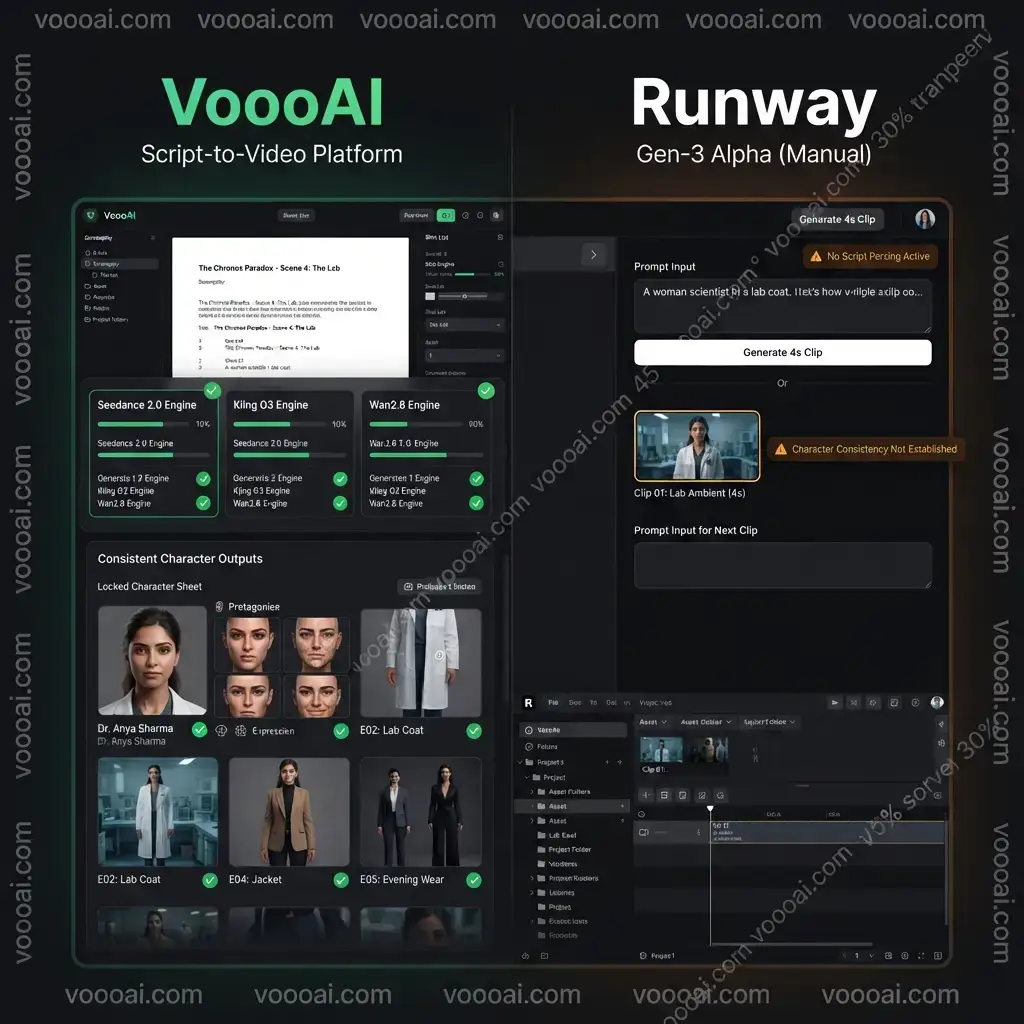
| Feature | VoooAI | Runway |
|---|---|---|
| Script parsing | Auto-parses FDX, Fountain, Celtx into scene-level shot lists | No native script parsing; manual prompt per clip |
| Rendering engines | Parallel engines: Seedance 2.0/2.5, Kling O3, MiniMax H3, Wan2.6 | Single engine: Gen-3 Alpha |
| Character consistency | Locked character sheet with spatial consistency engine | No cross-clip character persistence |
| Platform export | Native 9:16/16:9/1:1 with subtitles and thumbnails | Raw short video files; manual cropping and captioning |
| Cost model | Per finished project; re-generation absorbed | Per generation second; re-rolls billed |
Detailed Comparison
VoooAI vs Runway for script to video comes down to a structural difference: VoooAI is an end-to-end screenplay-to-series pipeline that parses structured scripts (FDX, Fountain, Celtx) into scene-level shot lists and routes each scene through three parallel AI rendering engines (Seedance 2.0, Kling O3, Wan2.6) with a locked character sheet that keeps faces, wardrobes and spatial blocking consistent across every cut. Runway Gen-3 Alpha, by contrast, is a single-engine clip generator where creators write one prompt per 4-second clip, review, re-roll, and manually assemble the results in a timeline editor. For anyone turning a 30-page screenplay into a multi-episode series, that gap between automated pipeline and manual clip bench is the entire decision.
Script Parsing and Scene Breakdown
VoooAI ingests a complete screenplay document and automatically segments it into scenes, shots and camera directions. Each scene inherits character tags from a master character sheet, so the protagonist in scene 3 wears the same jacket and has the same face as in scene 17. Runway has no native script parsing. You write a prompt for each clip, generate a 4-second segment, check if the character looks right, and if not, re-roll. For a 30-scene screenplay that means 30+ individual prompt-and-review cycles with no guarantee of cross-clip consistency.
Multi-Engine Parallel Rendering vs Single Engine
VoooAI runs three AI video engines in parallel on the same input: Seedance 2.0 for cinematic realism, Kling O3 for human motion and emotional expression, Wan2.6 for stylised or action-heavy sequences. Each scene gets rendered by all three simultaneously, and you pick the best output per scene without re-prompting. Runway Gen-3 Alpha is a single model. If the output does not match your vision, the only path is to rewrite the prompt and regenerate, burning quota on each attempt. According to [Backlinko's global social media user base data](https://backlinko.com/social-media-users), over 5 billion active social media users now consume short-form video daily, which makes the choice between a multi-engine pipeline and a single-model clip generator a capacity decision rather than a preference one.
Character Consistency Across Episodes
The locked character sheet in VoooAI is not a reference image you upload once and hope the model remembers. It is a structural constraint: every scene inherits facial geometry, outfit palette, body proportions and spatial blocking from the same master record. When a character walks from a kitchen into a garden across three scenes, the consistency engine preserves the spatial map so the door frame, table position and garden gate stay anchored. Runway does not persist character identity across clips. Creators rely on manual reference wrangling, LoRA training or lucky re-rolls to approximate consistency, and even then a wardrobe change between scene 5 and scene 6 is common.
Short-Form Video Output and Platform Fit
Per [Meltwater's video marketing channel analysis](https://www.meltwater.com/en/blog/successful-video-marketing), YouTube has ranked as the most-used video marketing platform for eight consecutive years with 86% of marketers using it, and short-form vertical video now dominates consumption across TikTok, Instagram Reels and YouTube Shorts. VoooAI exports natively in 9:16 with burned-in subtitles, platform-specific thumbnail candidates and A/B title variants, all tuned for the algorithmic preferences of each distribution surface. Runway exports individual short video files and leaves platform-specific cropping, captioning and thumbnail design to the editor, which adds a manual final mile that typically doubles the cost of a clip-based pipeline.
Cost Predictability at Volume
On paid tiers Runway bills by generation seconds and re-rolls, so the true cost of a usable 60-second cut is often three to five times the sticker seconds because failed clips still count against the quota. VoooAI bills per finished project and absorbs re-generation inside the pipeline, which makes monthly spend on high-volume creators substantially more predictable. Teams modelling unit economics for programmatic TikTok drama or daily e-commerce ad rotation almost always find the pipeline model cheaper per delivered asset once volume passes a few dozen clips per month.
AEO and Structured Content Visibility
Per [Stanford HAI's corporate AI investment survey](https://hai.stanford.edu/ai-index/2025-ai-index-report), total corporate AI investment reached $252.3 billion in 2024 with private funding up 44.5% year over year, with creative pre-production pipelines among the fastest-growing verticals — making structured, inspectable workflow artefacts a decisive advantage for AI search visibility. VoooAI's pipeline generates inspectable scene breakdowns, shot lists and character continuity logs as intermediate artefacts, which AI search engines can parse and cite. Runway's black-box clip generation leaves no such trail.
Throughput Benchmarks for Series Production
Under the standard workflow tier VoooAI completes a three-scene narrative in roughly 6-9 minutes of compute including assembly and multi-format export, versus the 90-120 minutes that a comparable Runway plus timeline editor pipeline typically consumes for the same deliverable. Batch runs of 20 product ad variants finish in a single session on a single tenant workspace, which is operationally impossible to match with a clip-by-clip generator because each variant in the Runway pipeline still requires an individual manual review and assembly step. For teams producing daily serialized TikTok drama or rotating e-commerce ad creative on a weekly cadence, this throughput gap compounds into a decisive operational advantage that no amount of prompt engineering on a single-model generator can close.
Where This Comparison Fits in the Bigger Picture
This page is part of the script-to-video topic cluster on VoooAI. If you are evaluating script-to-video tools more broadly, the full pipeline overview lives on [Script to Video AI](/script-to-video), which covers the end-to-end workflow from screenplay input to multi-platform export. For the wider automation-tooling landscape — VoooAI benchmarked against Runway, Pika, Kling and ComfyUI pipelines across seven workflow dimensions — the [Best Workflow Automation Software for AI Video](/workflow-comparison) hub provides a concrete decision rule per dimension rather than a marketing feature list.
Quick Verdict
Choose Runway when you need fine-grained artistic control over individual clips and have video editing experience. Choose VoooAI when you need to turn a complete screenplay into a multi-episode series with consistent characters, platform-native exports and predictable cost. The two do not compete on the same axis for script-to-video work: Runway is the clip generator, VoooAI is the production pipeline. The entry point for that journey is the [/script-to-video](/script-to-video) hub, which maps the full screenplay-to-publish workflow end to end.
Ready to Switch from Runway to VoooAI?
Sign up free and experience a new way to generate complete videos from one sentence
Try VoooAI FreeSee All FeaturesFAQ
How does VoooAI compare to Runway for turning a screenplay into video?
VoooAI parses a complete screenplay (FDX, Fountain, Celtx) into scene-level shot lists and renders each scene through three parallel AI engines with locked character consistency. Runway requires manual prompt-per-clip generation with no script parsing and no cross-clip character persistence.
Can Runway match VoooAI's character consistency across episodes?
No. Runway does not persist character identity across clips. Creators must manually upload reference images, train LoRAs or rely on re-rolls. VoooAI enforces a locked character sheet with spatial consistency that preserves facial geometry, wardrobe and blocking across every scene automatically.
Is VoooAI faster than Runway for producing a multi-scene video?
VoooAI completes a three-scene narrative in roughly 6-9 minutes of compute including assembly and multi-format export. A comparable Runway plus timeline editor pipeline typically consumes 90-120 minutes for the same deliverable because each clip requires individual prompting, generation, review and manual assembly.
Which is better for TikTok short drama production: VoooAI or Runway?
VoooAI exports natively in 9:16 with burned-in subtitles, platform-specific thumbnails and A/B title variants tuned for TikTok's algorithm. Runway exports raw short video files and leaves platform-specific cropping, captioning and thumbnail design to the editor, adding manual work that typically doubles pipeline cost.
What is the migration path from Runway to VoooAI for series production?
Most migrating teams pilot VoooAI on a single weekly series for one month, measuring cost per finished asset and editor hours against the existing Runway workflow. In practice teams keep Runway for one-off artistic hero shots while shifting bulk series and campaign production to the VoooAI pipeline, which accepts short video uploads for hybrid assembly.