VoooAI vs Sora: Which AI Video Generator is Better?
What is the difference between VoooAI vs Sora?
VoooAI vs Sora comparison. See why VoooAI's workflow-based approach beats single-prompt video generation for short dramas, ads and serialized content.
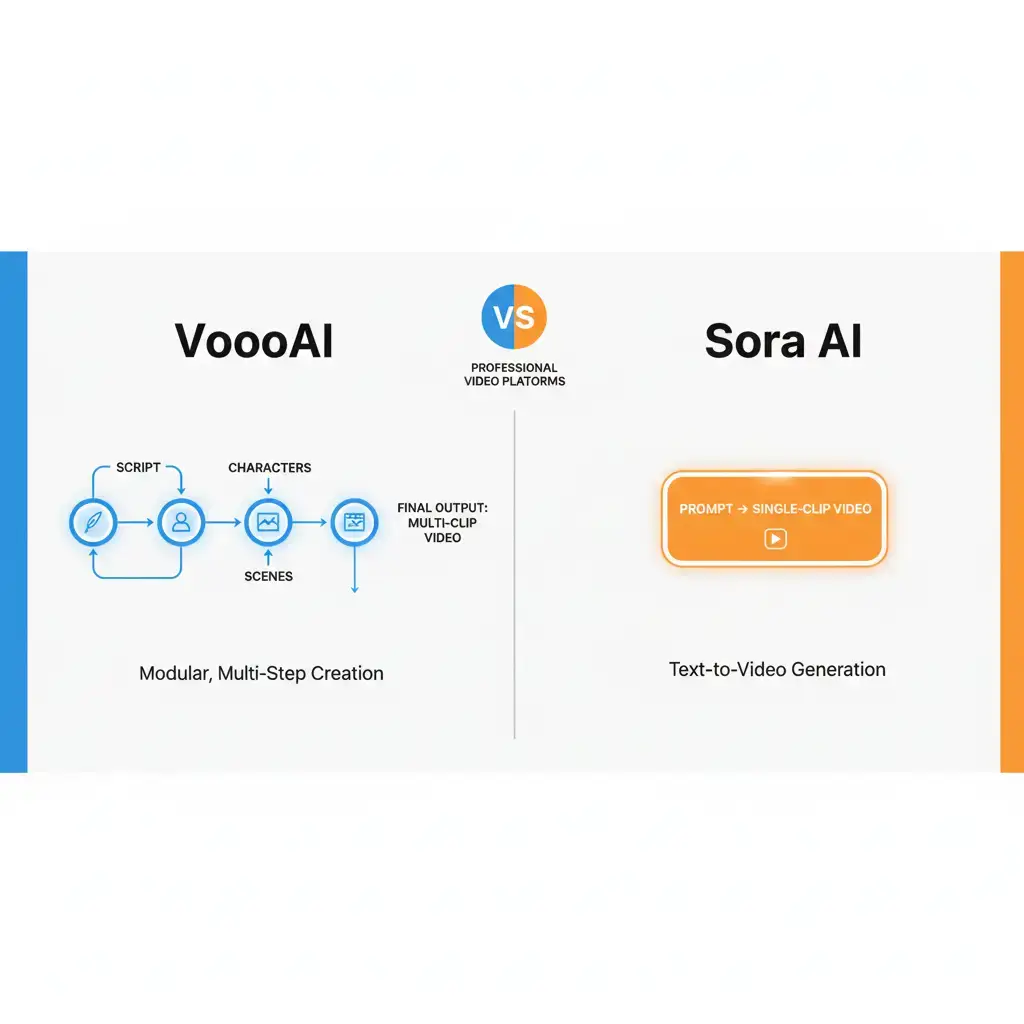
| Feature | VoooAI | Sora |
|---|---|---|
| Multi-episode series | Full support with character consistency | Single clips only |
| Character consistency | Built-in consistency engine | No cross-clip consistency |
| Workflow automation | Visual node-based workflow | Text prompt only |
| Ad video production | Templates + batch generation | Manual one-by-one |
Detailed Comparison
Sora generates impressive single clips from text prompts, but VoooAI takes a fundamentally different approach to AI video creation. While Sora excels at one-off short clips up to 60 seconds, VoooAI's NL2Workflow engine produces complete multi-scene productions with consistent characters, story arcs, and professional editing.
Core Architecture Difference
Sora operates on a single-prompt, single-output model: you type a description, you get one video clip. VoooAI operates on a workflow model: you describe a project (a 3-episode drama, a 20-product ad campaign, an anime series) and the engine plans, generates, and assembles the entire production automatically. This architectural difference means VoooAI handles projects that would require dozens of separate Sora generations plus manual editing.
Character Consistency
For serialized content, character consistency is non-negotiable. Sora generates a new interpretation of characters with every clip — different face shape, different outfit details, different style. VoooAI's reference-based consistency engine locks character appearances across unlimited scenes and episodes. Your protagonist looks identical in episode 1 and episode 10.
Market Momentum: The Capital Is Moving Toward Pipelines
According to [IDC's Asia/Pacific AI spending forecast](https://www.idc.com/resource-center/press-releases/asia-pacific-ai-genai-spending-2029-idc/), AI and generative AI spending in Asia/Pacific is projected to grow from $73 billion in 2024 to $370 billion by 2029 — a 38.4% compound annual growth rate — with GenAI alone reaching roughly $175 billion by 2029 at a 68.2% CAGR. Per [Stanford HAI's 2025 AI Index](https://hai.stanford.edu/ai-index/2025-ai-index-report), generative AI attracted $33.9 billion in global private investment in 2024, an 18.7% increase from 2023, while the share of organizations using AI jumped from 55% to 78%. When adoption accelerates this fast, the bottleneck stops being raw model quality and becomes throughput: how many finished, publish-ready videos a team can ship per week. That is the gap a production pipeline closes and a single-clip generator cannot.
Where AI Actually Sits in Video Production Today
[Wistia's 2026 State of Video Report](https://wistia.com/blog/video-marketing-statistics), which surveyed 900+ professionals and analyzed more than 13 million videos, found that over a third of teams already use AI somewhere in their video workflow and nearly a quarter more plan to start soon — and AI-adopting teams are 57% more likely to produce 50–100 videos than teams that have not adopted. Meanwhile, 76% of companies now publish at least one video every month, which turns video from an occasional art project into a repeatable production schedule. Sora fits the occasional art project well; VoooAI is built for the repeatable schedule, where the same cast, style, and brand rules must survive dozens of consecutive productions without manual policing between takes.
Cost Model: Paying for Clips vs Paying for Finished Video
Teams evaluating this workflow often compare it with [VoooAI vs Zapier](https://voooai.com/compare/voooai-vs-zapier-video-automation), [ReelShort Alternative](https://voooai.com/compare/best-reelshort-alternative-ai-video-generator), or [No-Code Workflow Automation Software for AI Video](https://voooai.com/use-case/no-code-workflow-automation-software) when the requirement differs slightly.
Sora's economics are per-clip: every generation consumes credits whether or not the take is usable, and a finished scene typically costs several re-rolls plus timeline assembly time on top. VoooAI's economics are per-project: re-generation happens inside the pipeline and is absorbed by the engine, so the price tracks the deliverable — a finished multi-scene episode — rather than the number of raw attempts. For teams modelling unit economics on serialized TikTok drama or daily e-commerce ad rotation, the per-project model is substantially more predictable once monthly volume passes a few dozen clips, because the failure cost that silently inflates clip-based budgets simply disappears from the ledger.
Review Cycles and Team Handoff
A single-clip tool leaves every review problem to the human: compare takes side by side, keep track of which character reference produced which clip, and manually re-render anything that drifts. VoooAI encodes review into the workflow itself — character sheets, style presets, and scene plans are versioned project assets, so a producer can approve a direction once and every downstream scene inherits it. Handoff changes shape too: instead of exporting loose short video clips and hoping the editor remembers the brief, the workflow delivers an assembled, channel-formatted bundle. For a two-person team this is a convenience; for a ten-person content operation it is the difference between one reviewer and ten.
Revisions, Localization, and Long-Run Content Ops
Serialized short-form content ships globally by default, and revision requests are routine. With Sora, any change — a different outfit, a new product colorway — means manually re-generating and re-assembling the affected clips, with no guarantee the character stays on-model. In VoooAI, the same change is a one-line edit to the project definition: the engine re-plans affected scenes, locked references stay intact, and only what changed gets re-rendered. Localization follows the same pattern — swap dialogue and on-screen text per market while the visual identity holds steady, so a drama shot for one audience can ship in three languages in the time it takes Sora to produce one new batch of standalone clips.
When to Choose Each Tool
Choose Sora for: artistic one-off clips, experimental visual concepts, single social media posts. Choose VoooAI for: TikTok drama series, e-commerce product ad campaigns, anime episode production, any project requiring multiple videos with consistent characters and narrative structure. VoooAI is the production pipeline; Sora is the single-shot camera. A hybrid also works in practice: many teams prototype hero shots in Sora, then feed the approved direction into a VoooAI workflow to scale it into a full series with locked characters.
Where This Comparison Fits in the Bigger Picture
This page is part of the workflow automation hub on VoooAI. If you are weighing several AI video tools and care about automation depth rather than raw model quality, the full head-to-head matrix — VoooAI against Sora, Pika, Kling and traditional timeline editors across seven workflow dimensions — lives on [Best Workflow Automation Software for AI Video](/workflow-comparison). Whichever way you decide, judge both tools on the same metric: finished, platform-native videos shipped per week, not clips generated per afternoon. It also changes how you plan headcount. A clip-based pipeline quietly converts your budget into editor hours — someone must watch, grade, cut, and re-order every take — while a project-based pipeline converts that same budget into finished episodes, letting a small team sustain a daily publishing cadence without growing an editing bench. For the full seven-dimension matrix behind this verdict — automation depth, character consistency, cost model, revision flow and export fit — the [Best Workflow Automation Software for AI Video](/workflow-comparison) hub remains the canonical reference.
Ready to Switch from Sora to VoooAI?
Sign up free and experience a new way to generate complete videos from one sentence
Try VoooAI FreeSee All FeaturesFAQ
Is VoooAI better than Sora for short drama?
Yes. VoooAI is specifically designed for multi-episode content with character consistency, while Sora generates single isolated clips without narrative continuity.
Can I use both VoooAI and Sora together?
VoooAI's workflow can integrate multiple AI engines. You could use Sora-generated clips as reference inputs within a VoooAI production pipeline.
Which is more cost-effective for business use?
VoooAI offers subscription plans with batch generation capabilities, making it more cost-effective for businesses needing regular video content at scale.
Can Sora keep the same character across multiple clips?
No. Sora treats every prompt as an independent generation, so faces, outfits, and style tend to drift between clips. VoooAI locks a character sheet and applies it to every scene automatically, which is why serialized formats like short dramas are produced on VoooAI rather than assembled from isolated Sora clips.
Is VoooAI more expensive than Sora?
Not at production scale. Sora charges per generated clip and failed takes still consume credits, while VoooAI bills per finished project with re-generation included in the pipeline. Once a team ships more than a few dozen clips a month, the per-project model usually costs less per usable, publish-ready video.