VoooAI vs Make.com: Which One Actually Ships Video?
What is the difference between VoooAI vs Make.com?
VoooAI vs Make.com for video automation: why integration glue stops at the file boundary while a native AI canvas ships finished, platform-native episodes.
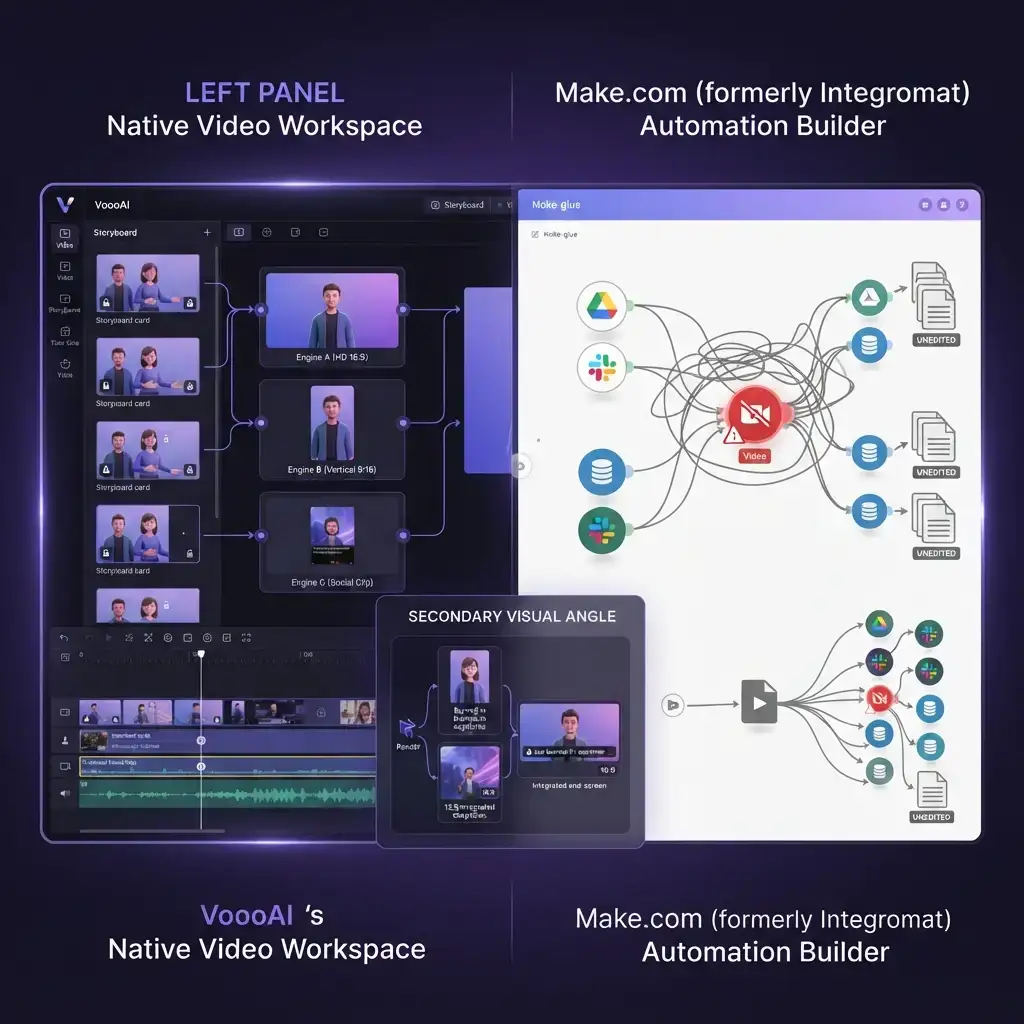
| Feature | VoooAI | Make.com |
|---|---|---|
| Native video generation | Multi-model engine graph (Seedance 2.5 / Kling / MiniMax H3) | None; must bolt on third-party APIs |
| Character consistency | Character locking across episodes | Not applicable (no rendering) |
| Platform-native variants | Horizontal-to-vertical reframing + burned captions in one render | Routes files only, cannot re-cut |
| Failure cost model | Points refunded on failed tasks + engine failover | Per-operation billing charges failed runs |
Detailed Comparison
Make.com (formerly Integromat) is one of the most popular visual automation platforms in the world, but the VoooAI vs Make.com video automation comparison comes down to a single distinction: Make connects apps, while VoooAI creates video. If your goal is finished short dramas, ad variants and serialized episodes rather than data moving between SaaS tools, that distinction decides everything below. VoooAI's NL2Workflow engine turns one sentence into a multi-engine production pipeline, and this page explains exactly where a general-purpose glue platform stops being enough.
What Make.com Actually Automates
Make orchestrates scenarios: visual chains of modules that move payloads between hundreds of APIs. It is excellent glue. It is not a video generator. To produce video inside a Make scenario you must bolt on third-party generation modules (Runway, HeyGen, or raw API calls), each with its own billing account, rate limits, payload schemas and output formats, then route the resulting files to a human editor for assembly, captions and platform crops. The automation stops at the file boundary.
That architectural gap matches where enterprise AI money is actually going. According to [IDC's AI infrastructure spending breakdown](https://www.idc.com/resource-center/press-releases/asia-pacific-ai-genai-spending-2029-idc/), AI infrastructure provisioning is the leading use case at roughly 39% of total AI spending, and the software and information services sector alone accounts for more than 47% of AI spend in 2026 — evidence that organizations consolidate budgets into integrated AI platforms instead of maintaining fragile glue stacks of point APIs.
Where VoooAI's Native Canvas Wins
VoooAI treats a video project as a first-class object. One prompt becomes a visual workflow: script parsing, storyboard cards, character locking, parallel rendering across Seedance 2.5, Kling and MiniMax H3, then timeline editing on the same canvas. There is no module marketplace to browse and no JSON payload to debug, because generation, consistency and editing live in one engine graph.
The director-style pipeline matters more than it sounds. Each storyboard card carries its own character lock, camera intent, duration and engine assignment, so episode three inherits episode one's face geometry without anyone re-uploading reference images. When you re-time a shot on the timeline, only the affected card re-renders; the rest of the episode stays byte-identical, which is exactly the iteration loop a serialized drama needs and exactly the loop a glue platform cannot express, because Make has no notion of a shot.
If this use case is adjacent to what you need, see also [VoooAI vs n8n for AI Video](https://voooai.com/compare/voooai-vs-n8n-for-ai-video), [VoooAI vs Runway](https://voooai.com/compare/voooai-vs-runway), and [VoooAI vs Runway Script to Video](https://voooai.com/compare/voooai-vs-runway-script-to-video) for the closest alternative workflow.
The demand side makes this urgency obvious. According to [OptinMonster's video adoption and cost survey](https://optinmonster.com/video-marketing-statistics-what-you-must-know/), a record-high 96% of marketers call video an important part of their content strategy, while 42% of video marketers spend between $0 and $500 per average video. Universal demand meets thin budgets: a DIY glue pipeline adds per-clip API invoices plus editor hours on top of every iteration, whereas VoooAI's points-based pricing keeps the cost of one finished episode predictable before you press render.
The Integration Tax Nobody Counts
Glue platforms bill per operation and age per vendor release. A Make scenario touching three video APIs inherits three changelogs: when one vendor revises an auth flow, renames a field or tightens a quota window, every scenario carrying that module needs retesting, and failed runs still consume operations while nobody watches. That tax is invisible in month one and dominant by month six, paid in engineer evenings rather than invoices.
VoooAI absorbs the same instability inside the engine layer: automatic failover reroutes a timed-out render to a healthy model, and points spent on failed tasks are refunded, so a bad vendor day costs you minutes of wall-clock time instead of a debugging session across three dashboards. None of this appears on a procurement spreadsheet, which is precisely why it survives.
Multi-Platform Format Reality
Distribution today is format-fragmented. According to [Meltwater's short-form platform shift analysis](https://www.meltwater.com/en/blog/successful-video-marketing), 33% of marketers planned to add TikTok to their video strategy in a single year, a 13-point jump, and the same analysis notes YouTube remains the strongest channel for brand awareness while under-delivering on clicks and conversions. In practice every channel wants a native cut: vertical reframing, burned-in captions, hook-first openings.
Concretely, one episode becomes a variant matrix: a 9:16 hook-first cut with captions for TikTok, a 16:9 version with end-screen padding for YouTube, a square silent-readable cut for feeds. Make can route the finished file to ten destinations, but it cannot reframe, re-caption or re-cut it. VoooAI's horizontal-to-vertical reconstruction and subtitle pipeline emit that matrix from one render pass, which is the difference between distributing a video and shipping a campaign.
Cost And Maintenance Over A Year
Stack the two models side by side for twelve months of daily publishing. The glue path pays per-operation fees on every retry, per-vendor subscriptions on every generation module, and permanent maintenance on every schema drift. The native canvas path pays points per finished minute, refunds failures, and asks you to maintain a storyboard. Only one of those surfaces shrinks as your team learns it. Teams publishing daily feel this asymmetry fastest: the glue stack's maintenance burden grows with every vendor it touches, while the canvas stack's burden falls as storyboard templates accumulate and get reused across episodes and campaigns.
When Make Still Makes Sense
Fairness matters in a comparison. If video is one node among two hundred SaaS integrations — CRM to spreadsheet to email — Make remains the right tool for the other 199 nodes, and nothing here argues otherwise. Many mature teams run both: Make for the operational backbone, VoooAI for the content engine. The mismatch appears only when video is the product: at that point a glue layer adds latency, cost and breakage between you and the artifact you sell.
Verdict
Choose Make.com to connect your stack; choose VoooAI when the stack's output must be a finished, platform-native video. Three questions settle it fast: is the deliverable a file or a payload, does consistency span episodes, and does each channel need its own cut. If any answer is yes, the canvas beats the glue. Judge both on shipped episodes per week rather than scenarios executed, and see the full platform evaluation in [Best Workflow Automation Software for AI Video](/workflow-comparison).
Ready to Switch from Make.com to VoooAI?
Sign up free and experience a new way to generate complete videos from one sentence
Try VoooAI FreeSee All FeaturesFAQ
Can Make.com generate AI video on its own?
No. Make.com is an integration layer with no native generation engine; it must call third-party video APIs and still leaves editing, captions and platform crops to humans.
Which is cheaper for daily short-drama production?
VoooAI. Points-based pricing plus failed-task refunds keep per-episode cost predictable, while a Make glue pipeline stacks per-clip API invoices and editor hours on every iteration.
Does VoooAI integrate with other apps like Make does?
VoooAI focuses on the video production graph (script, storyboard, multi-engine render, timeline) rather than general SaaS glue; for non-video integrations teams typically keep Make alongside it.
Which tool handles character consistency across episodes?
VoooAI, via character locking in storyboard cards shared by every episode's workflow; Make has no concept of characters because it never renders frames itself.
Can Make route VoooAI outputs to social platforms?
Yes, and that combination is legitimate: VoooAI renders platform-native variants (vertical, captioned) and Make can distribute the finished files to your other tools.