From One Sentence to a Multi-Episode AI Short Drama Series
Turn one sentence into a cinema-grade multi-episode AI short drama series at 1/10 traditional cost, with consistent characters.
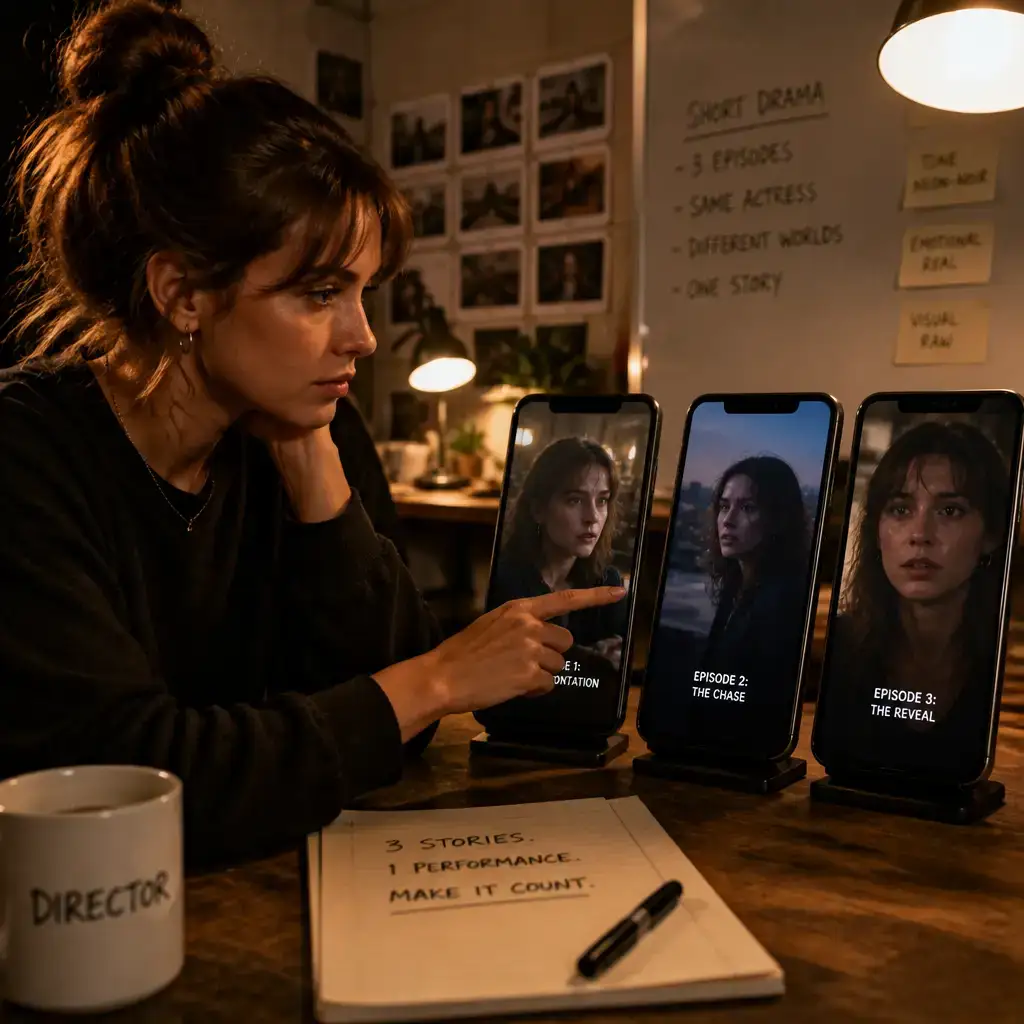
Short drama has become the fastest-growing scripted video format on mobile platforms. Vertical episodes of one to three minutes, released in sequences of three to ten parts, now outperform single clips on completion rate and follower retention because each cliffhanger pulls the viewer into the next installment. Deloitte's 2026 technology, media and telecom predictions forecast that in-app micro-series revenue will more than double this year to reach 7.8 billion dollars, and independent creators are building lean studios that challenge traditional production houses. The bottleneck was never audience appetite. It was cost: a conventional three-episode vertical series demands script fees, casting, locations, equipment and editing that together run into tens of thousands of dollars and several weeks of calendar time. An orchestrated AI workflow collapses that budget to roughly one tenth by replacing crew logistics with model orchestration while keeping the narrative craft human.
What a Multi-Episode AI Short Drama Series Looks Like
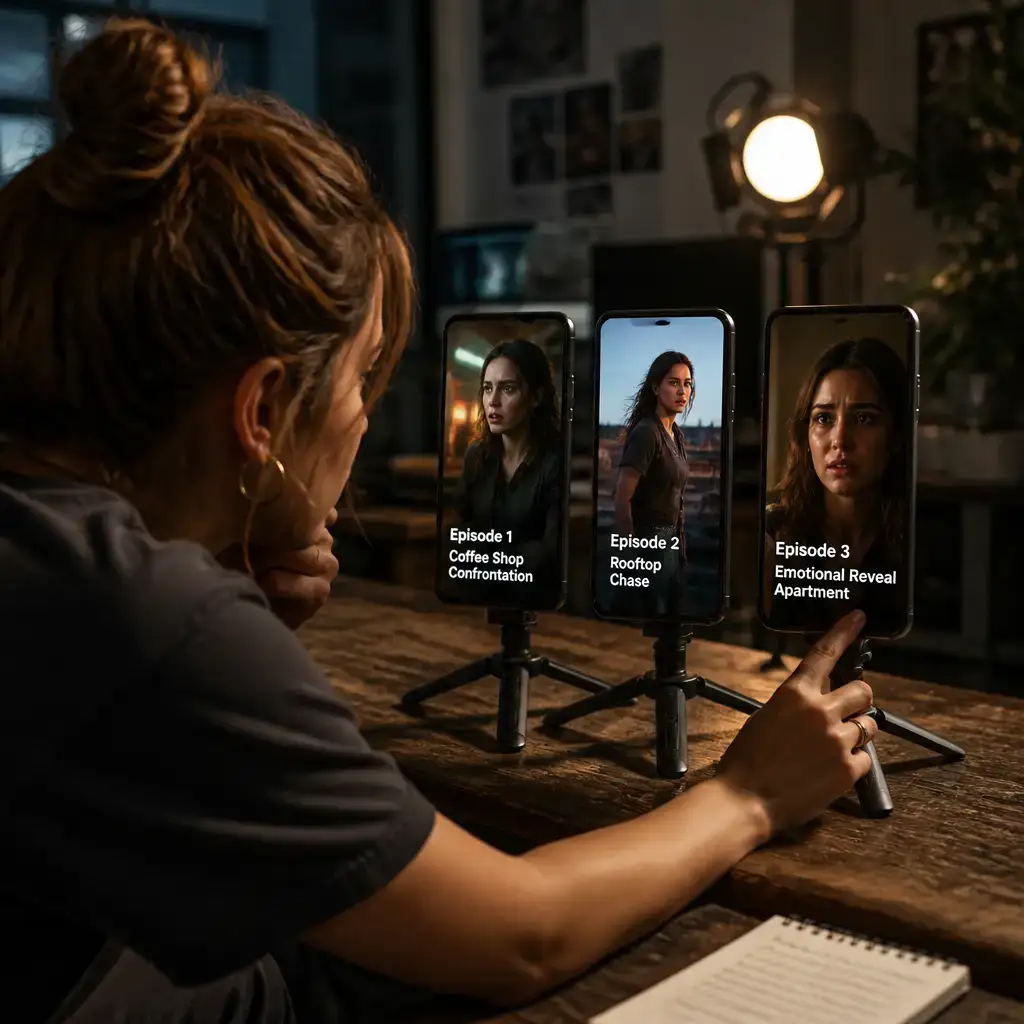
A multi-episode AI short drama series is not a single long video chopped into parts. It is a planned sequence: a premise expands into a script, the script splits into episodes, each episode splits into scenes, and each scene becomes a rendered shot with dialogue, camera language and sound. The defining requirement is continuity. The protagonist's face, wardrobe and color grading must survive every cut, otherwise viewers feel the seam and swipe away. VoooAI addresses this with a reference-image pipeline that locks facial geometry and outfit details, plus prompt-level style guards that inject identical lighting and lens keywords into every generation call. The result behaves like footage shot on one production schedule even though every frame was synthesized independently.
Step 1: Write One Sentence That Carries the Whole Story
Everything starts with one sentence that carries conflict and direction. A courier discovers her last delivery is a message from her future self: that premise gives the engine a protagonist, a stake and a twist, while a vague note about nice cats gives it nothing. Write the premise as a person plus a problem plus a turn. Keep names simple so the consistency pipeline can anchor them, and state the visual register you want, for example neon noir or warm documentary, because the first prompt sets the style sheet for the whole series. Resist the urge to write full dialogue at this stage. Dialogue is cheap to generate later; a muddled premise is expensive to fix after rendering.
Step 2: Let the Engine Break the Story Into Episodes
Hand the premise to the workflow and the engine expands it into a beat sheet, then into episodes. Three episodes is the smallest unit that supports a full arc: setup, confrontation, payoff. Each episode targets three to five scenes of fifteen to thirty seconds, tuned to the attention window of vertical feeds. The engine places a cold open in the first three seconds, a mid-scene hook near the sixty percent mark, and a cliffhanger on the final frame of every episode except the last. Review the beat sheet before rendering. Moving a beat on paper costs nothing; moving it after rendering costs a full scene regeneration.
Step 3: Lock Characters and Scenes Before Rendering
Before the first frame renders, lock the cast and the world. Generate one reference portrait per character and one style frame per recurring location, then attach them to every scene that features them. This is the step creators skip most often and regret most deeply, because drift compounds: a jacket that changes shade in episode two reads as a different story in episode three. Locking references takes minutes and pays for itself across the whole series. It also makes reshoots trivial. When a scene fails quality review, you regenerate that scene against the same references and the series stays visually coherent.
Step 4: Render, Review and Export Vertical Episodes
Rendering runs scene by scene on parallel engines, with each shot routed to the model that handles its motion type best: dialogue close-ups, physical action, establishing drone moves. Voice-over and background music are generated against the locked cut, and subtitles are burned into the lower third so platform interfaces never cover them. Review each episode as a whole before export, watching specifically for continuity errors at scene boundaries. Export at 1080 by 1920 for TikTok, Reels and Shorts; the same project re-frames into a stitched full-length cut for a channel page with almost no extra work because every scene already shares one style sheet.
The Real Cost Math: Traditional Production vs AI Workflow
The cost math is where the workflow changes who can play. A traditional three-episode vertical series budgets script writing at five hundred to two thousand dollars, casting and actors at two to ten thousand, equipment and locations at one to five thousand, and post-production at one to three thousand, landing between four and a half and twenty thousand dollars over two to four weeks. The AI pipeline prices the same deliverable in generation credits, typically fifty to two hundred dollars, delivered in hours rather than weeks, roughly one tenth of the traditional floor. The saving is not a discount on the same process; it is the removal of the process itself. No call sheets, no location permits, no reshoot days.
Where the Workflow Still Needs a Human
The workflow automates production, not judgment. A human still chooses the premise, approves the beat sheet, decides which cliffhanger earns the next tap, and rejects renders that feel flat. Taste is the scarce input now that rendering is cheap. Creators who treat the engine as a crew rather than an author get the best results: they direct, they cut, they say no. The teams that fail are the ones that export the first draft untouched and wonder why retention collapses at episode two.
Other Creations That Reuse the Same Pipeline
The same pipeline serves far more than short drama. Wedding films become narrative sequences built from a couple's story and photos. Tutorial channels turn lesson outlines into consistent presenter-led episodes. Photo albums animate into memory films with locked faces across decades of images. Game communities adapt character lore into cinematic shorts, and film fans produce creative derivatives of universes they love. Brand teams run the identical workflow for marketing series, swapping the cliffhanger for a product reveal. One locked pipeline, many genres: that reuse is the real economic story behind the one-tenth cost figure.
What 172 Community Prompt Packs Taught Us About Reuse
The reuse claim above is not marketing optimism, so we stress-tested it against how creators actually share work. In September 2026 we read 172 publicly posted skill packs from a third-party AI video community — prompt templates, storyboard tables and style bibles that creators trade to skip setup work — public text only, no user data. Five copy patterns dominate: official template families that repeat 12 to 70 percent of their lines verbatim; director-style packs that are one skeleton with a swapped vocabulary list; multi-document film bibles; storyboard tables locked to a fixed shot grid; and whole files where only the planner sheet changes. Almost none of it is parameterized. Creators duplicate prose and hope the engine behaves the same next month, which is why the most careful packs hard-code engine limits into the artwork itself, down to a written cap of roughly four minutes and 48 to 54 shots per render.
The cleverest finding sits at the seams between shots. One pack ends every scene with an empty landscape and requires the final shot to contain no people, because generation cannot carry a character's state between separately rendered segments; an empty frame hides the cut where nothing can be inconsistent. That is a model limitation patched as a style rule, and it describes the honest state of the art: a character's look carries across episodes through reference images, while the performance does not carry at all. Per-episode economics make closing that gap worthwhile — the VoooAI internal benchmark (September 2026) puts a 60-second vertical episode at roughly 42 hours and 1,800 dollars of manual work, against about 11 minutes of automated rendering.
Getting Started and Where to Go Next
Start small and finish complete: one premise, three episodes, one locked cast, one export. Measure completion rate and follow-through between episodes before scaling to longer seasons or multiple series in parallel. When you are ready to move from manual steps to a fully orchestrated pipeline, the canonical reference is the script-to-video hub at https://voooai.com/script-to-video, and the workflow comparison matrix at https://voooai.com/workflow-comparison shows how orchestrated multi-engine production stacks against single-model tools. Sources for the market figures in this analysis: Deloitte 2026 TMT predictions, https://www.deloitte.com/us/en/insights/industry/technology/technology-media-and-telecom-predictions.html and Metricool TikTok statistics, https://metricool.com/tiktok-statistics/.
Frequently Asked Questions
How many episodes should a first AI short drama series have?
Three. A three-episode arc is the smallest structure that supports setup, confrontation and payoff, and it keeps the first production cycle short enough to learn from.
How does character consistency survive across episodes?
A reference-image pipeline locks facial geometry, wardrobe and color grading, while prompt-level style guards repeat identical lighting and lens keywords in every generation call.
What does the workflow cost compared with traditional production?
Roughly one tenth of the traditional floor: generation credits instead of crew, locations and equipment, with delivery measured in hours instead of weeks.
Do I need editing experience to run this workflow?
No. The engine plans, renders and assembles; the creator directs taste-level decisions such as premise, beats and final cut approval.